
Home / About Dr. Phil / Electroacupuncture & microcurrent
About Dr. Phil · Electroacupuncture & microcurrent
Electroacupuncture and microcurrent in Scottsdale
Electricity is how your nerves, muscles and brain talk to each other. Working with it is a large part of how I practice, from stubborn back pain to Parkinson's.
90-min first visit · 1:1 with Dr. Phil · frequency chosen for you, not a preset
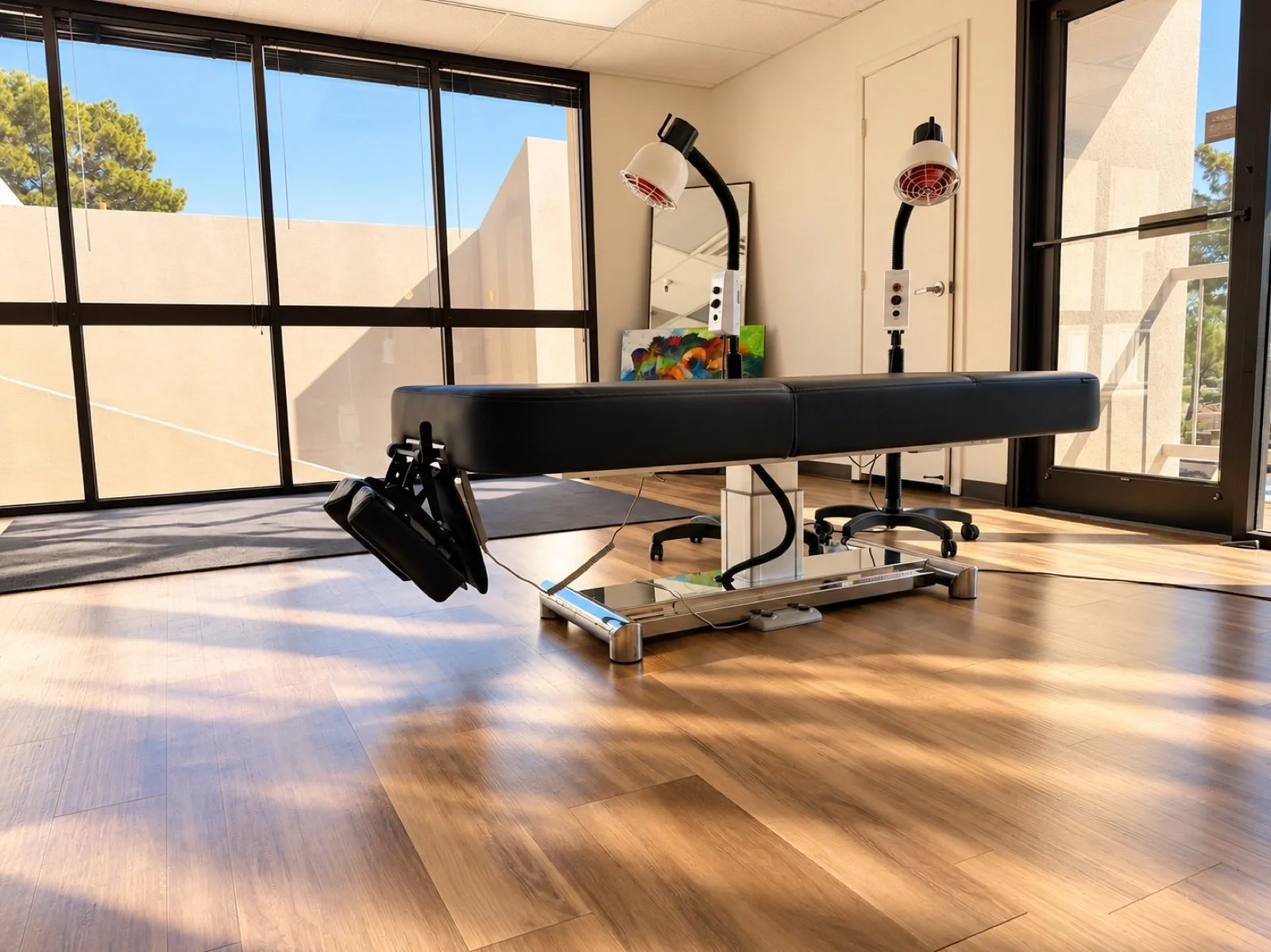
Your comfort matters
Settle in. We adjust to you.
The table moves so you don't have to.
- 18″low entry height
- 32″extra-wide surface
- Lift + tiltrises to hip height and adjusts your position
- Plushextra-soft cushioning
How I practice
Why electricity sits at the center of my work
Every movement you make starts as an electrical signal. A thought in the motor cortex travels down the spinal cord, jumps to a nerve, and tells a muscle to contract. Pain travels the same wiring in reverse. When that signalling gets stuck, through injury, inflammation or a nervous system that has stopped listening, the tissue gets stuck with it.
A still acupuncture needle sends one quiet message. Add a gentle current and I can keep that message going for the whole session, at a frequency matched to the tissue I'm trying to reach. That's why electroacupuncture and microcurrent are part of most of my treatments, not an add-on.
Training
Electro-Acupuncture Medicine
My electroacupuncture is built on Electro-Acupuncture Medicine (EAM), the system developed and taught by Dr. Jeremy Steiner of the ElectroAcupuncture Institute. EAM pairs traditional point selection with specific stimulation frequencies, chosen for what the nervous system needs, rather than one setting for everyone.
It's how I treat neurology issues. For Parkinson's disease, tremor, peripheral neuropathy, recovery after stroke, and memory and cognitive changes, EAM gives me a structured way to work with nerve pathways, scalp and ear points, and the muscles the nervous system has stopped using well. I work alongside your neurologist, never instead of them, and I'll be honest about what's realistic.
Microcurrent, in short. Most stimulators push current in milliamps, enough to make a muscle jump. Dr. Steiner teaches working in microcurrent: millionths of an amp, closer to the scale of the body's own electrical signals, so most people barely feel it. The goal isn't force, it's the message. Each frequency is chosen for a target tissue or signalling chemical, like the body's own endorphins, and the needles carry it through muscle and fascia, which conduct electricity.
Not the same thing
Electroacupuncture vs. dry needling vs. TENS
All three can involve a needle or a current. That's where the similarity ends.
Electroacupuncture (EAM)
- Current delivered through needles, past the skin, into muscle, fascia and the nerve pathways around them
- Frequency chosen for a target: a guarded muscle, an irritated nerve, or the body's own pain-relieving chemistry
- Microcurrent-level stimulation, often barely felt
- Points chosen from a full diagnosis, including scalp and ear points for the brain and nervous system
- Part of a whole plan: bodywork, herbal medicine and home care
Dry needling
- A needle into a muscle trigger point to make it twitch and release
- Usually no current, and no frequency strategy
- Focused on the muscle in front of it, not the nerve pathways or the brain
- Often a short add-on inside a physical therapy or chiropractic visit
TENS unit
- Current through sticky pads on the skin, and skin is the body's least conductive layer
- Mainly crowds out pain signals while it's switched on
- Preset programs, usually milliamp level
- No needles, no diagnosis, no point selection
Dry needling and TENS have their place. If you've tried them and the problem keeps coming back, electroacupuncture works on a different level: the signalling underneath the muscle.
Auricular electroacupuncture
The ear: a direct line to the brainstem
The outer ear is the only place on the surface of your body where a branch of the vagus nerve reaches the skin. That branch, in the hollow of the ear, runs straight to the brainstem, the control center for heart rate, digestion, inflammation and much of the autonomic nervous system. The ear also carries branches of the trigeminal nerve and the upper cervical nerves.
That makes the ear one of the most efficient doors into the nervous system. Fine needles or microcurrent at specific ear points, a method Dr. Steiner teaches as part of his auricular medicine work, let me reach brain and brainstem circuits without going anywhere near the head with anything more than a tiny needle. It's why auricular electroacupuncture is the core of my neurology care.
Auricular electroacupuncture for Parkinson's, tremor, dementia and stroke recovery is the foundation of the Neurology Intensive.
Your visit
What a session looks like
- Talk and examYour history, what makes it worse, and a hands-on look at how you move.
- Needles and currentI place the needles, connect the pairs that matter, and set the frequency and level to your comfort. You rest for 20 to 30 minutes.
- Hands-on workFor spine care, targeted bodywork on the muscles the exam pointed to.
- Your planWhat to do at home, and whether and when to come back.
Your first visit is 90 minutes. For back, neck and hip pain, book the Spine Assessment. For everyday pain and recovery, book an Everyday Health first visit. For neurological conditions, start with the Neurology Intensive.
Common reasons
What I use it for
- Low back pain and stiffness
- Sciatica and leg pain linked to the back
- Neck and shoulder tension, and headaches that start in the neck
- Neurological conditions: Parkinson's, tremor, neuropathy, stroke recovery, memory changes
- Hip and glute pain
- Sports and overuse strains, and muscle tension that keeps coming back
Is it safe? The current is low and I control it the whole time. Electroacupuncture isn't right for everyone: tell me if you have a pacemaker or other implanted electrical device, if you are pregnant, or if you have a seizure disorder. I'll check this at your first visit and adjust the plan.
Questions
Electroacupuncture FAQ
Does electroacupuncture hurt?
Most people describe a light tapping, or feel nothing at all with microcurrent. The needles are far thinner than injection needles, and the level is set to your comfort.
Is electroacupuncture the same as dry needling?
No. Dry needling targets a muscle trigger point, usually without current. Electroacupuncture sends a chosen frequency through the needles to work on nerve pathways and tissue signalling, based on a full diagnosis.
Is it the same as a TENS unit?
No. A TENS unit sends current through pads on the skin and mostly masks pain while it runs. Electroacupuncture delivers current through needles placed in the tissue, at frequencies chosen for a specific target.
Why the ear for neurological conditions?
The ear is the only place on the skin where a branch of the vagus nerve surfaces, and it leads straight to the brainstem. Auricular electroacupuncture is the core of the Neurology Intensive.
Who trained you in electroacupuncture?
I use Electro-Acupuncture Medicine, the system developed and taught by Dr. Jeremy Steiner of the ElectroAcupuncture Institute.
Do you take insurance?
ATRIUM is in network with BCBS of Arizona, depending on your plan. Most care is self-pay.
Keep reading
Related care and articles
See if electroacupuncture fits
Book a first visit, or talk it through with me first on a free discovery call.
